

Moment Joon has renamed himself after a man from Chelyabinsk

The rapper Moment Joon renamed himself VIKTOR KIM today and released a 15-track album of the same title this morning, moving between Japanese, English, Korean and Russian.
The record carries twelve credited guests and arrived with a published statement written in all four languages at once, switching language inside single sentences. It says everything began from one misunderstanding, innocent, yet fatal nevertheless, before shifting into Korean, then Russian, then Japanese.
The Osaka rapper's new album arrives under a new name, in four languages, with a statement that refers to its author in the third person.
That statement refers to Viktor in the third person. It describes him believing his purpose was to make something larger than himself, and lists what that might have been: people, message, history, art, each word set in a different script.
Renaming is normally a legibility exercise. An artist adopts something shorter, easier to say in the market they are trying to enter, easier to file. This does the reverse.
He was born in South Korea, has lived in Osaka, and has been releasing music in Japanese since 2011, performing as Moment Joon since 2019, according to his distributor's biography, which describes him as an immigrant rapper. His 2020 album Passport & Garçon was received as a turning point for conscious rap in Japan.
He also publishes in Japanese. Iwanami Shoten, one of the country's most serious houses, brought out his semi-autobiographical novel SANDAI and his essay collection Nihon Imin Nikki, and he is currently serialising a column on the publisher's website.
Fifteen years of that work has been built on being identifiable — a Korean man writing in Japanese about being a Korean man in Japan, under a name audiences learned. Viktor Kim is not that. It pairs a Russian forename with the commonest Korean surname, and it belongs to nobody in particular.
The handover was staged rather than sprung. The single "WAR" was released in early August credited to both names, and his own account ran a countdown to the album under the new one.
That account now describes him as 29 and from Chelyabinsk.
The album's guests reach well past the rap scene it comes from. The fifth track is the novelist Ando Hose, who won the Akutagawa Prize, reading a very short story written for the record. The tenth is Ahn Sung Min, an inheritor of the Korean vocal tradition pansori, performing SuGung Ga.
Two tracks carry Russian titles, КРАСНО and Потому Что, and a third is addressed to Viktor directly, asking in Russian whether it is true that he is alive.
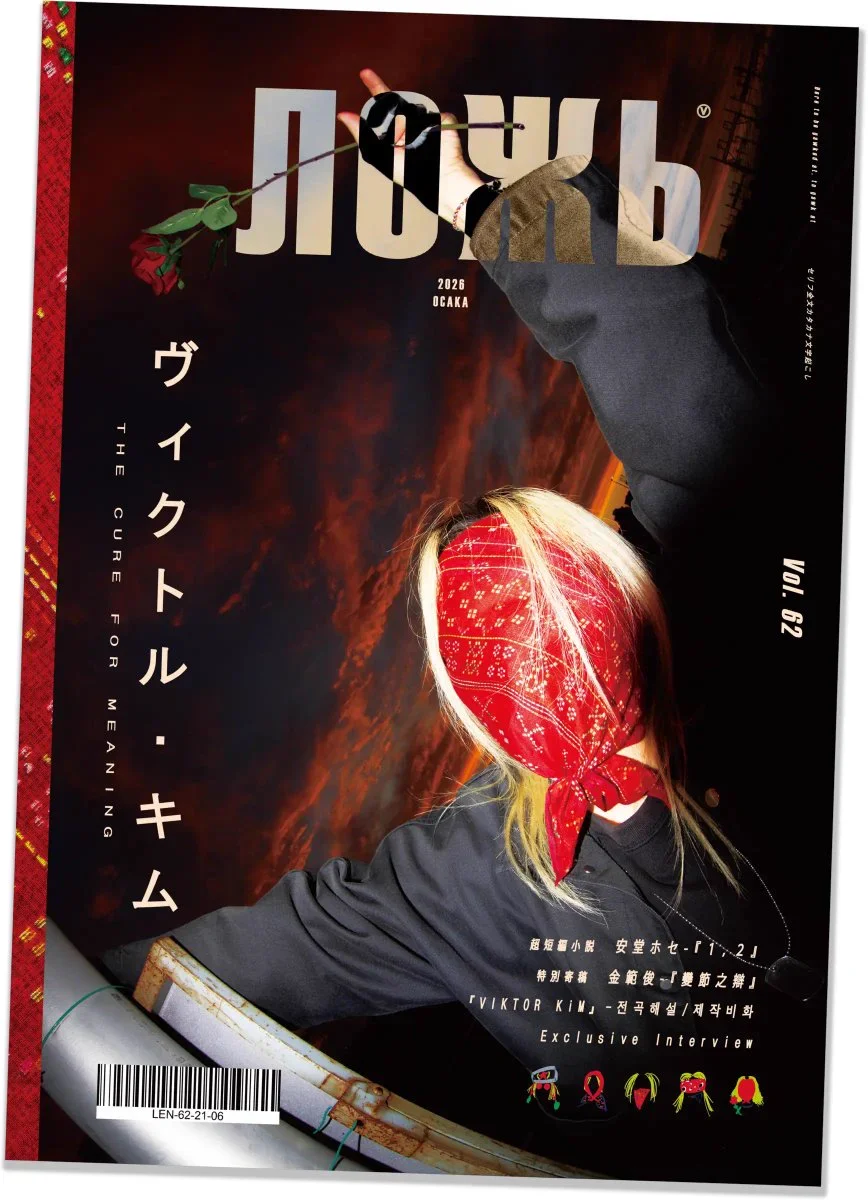
Alongside it he published a magazine, ЛОЖЬ vol.62 — the Russian word for a lie — presented as a visual album and carrying track commentary, interviews, Ando's fiction and essays.
There is a reading in which all of this is a lot of apparatus for one record, and an artist with a hard-won readership making himself deliberately difficult. It is a fair objection, and the last six years of his output are the answer to it: the difficulty has always been the work.
His own account still lists Viktor's age as 29. He is not 29.
SOURCES (1) (2) (3) (4) (5)RELATED ARTICLES

LATEST


MORE IN:
Moment Joon released a 15-track album under a new name on Monday. Its statement is written in four languages and refers to its author in the third person.